Rick
Bird BoxRick is the voice that turns a remote refuge into a destination for Malorie and her children, and the person who greets them when they arrive at Tucker School. Through a telephone call, a recorded message, and finally a face-to-face explanation, he links Tom’s effort to find help with a community that has endured its own losses and changed its way of surviving. His welcome offers practical safety, but the history he recounts also shows that safety at Tucker was built through painful choices and collective adaptation.
Identity and First Contact
Rick first enters Malorie’s story through a telephone line that has survived the wider collapse of communications. When he calls, he says that the community received a message from a man named Tom. He asks whether Malorie wants to leave her current shelter for somewhere safer; she says yes, and Rick begins giving her directions. The call establishes him as a contact able to offer a real destination rather than reassurance alone.
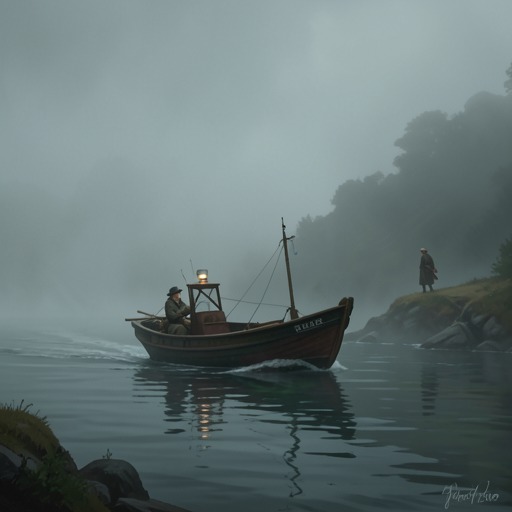
Rick’s instructions are specific because reaching Tucker is not straightforward. He tells Malorie to travel by river for at least twenty miles, then warns that the river divides into four channels. The correct route is the second channel from the right, so simply following the right bank will not work. Rick tells her she will have to open her eyes to identify the route, making arrival depend on a dangerous departure from the visual precautions that have governed her life.
Guidance and the Route to Tucker
Rick also explains how the final approach is designed to alert the community without requiring visitors to find their way inside unaided. After Malorie takes the correct channel, she must continue another hundred yards. An alarm system, using the same technology as the recording she will hear, will trigger a lowered fence and leave the arriving boat caught there. Tucker’s residents will then come to investigate what has been stopped by the fence. The system is both a warning and a controlled point of contact: it signals an arrival while keeping an unknown visitor outside until the community can respond.
The route depends on more than Rick’s directions. Tom’s voice is used in the recording that guides people to the facility. Rick later explains that the community had expected Malorie, making Tom’s voice a way to identify and guide her. But it also serves a broader purpose: if someone else were caught by the fence, the recording would indicate that some kind of civilization was nearby. Rick acknowledges that he would have insisted on using another voice had he known Tom was no longer with Malorie. His apology shows how the plan’s usefulness and its emotional meaning had become inseparable from the person whose message made the connection possible.
Arrival and Welcome
When Malorie reaches the school, Rick is physically present to greet her. She recognizes his voice from a telephone conversation years earlier and opens her eyes in the facility’s bright hallway. Rick’s long absence from her life makes the recognition moment a return of a voice she had wondered whether she would hear again. His presence confirms that the destination described over the telephone is real, but Malorie does not immediately trust the people around her; she tells them to stay away and not touch her.
Rick’s manner contrasts with the uncertainty Malorie brings into the hall. He speaks with hope and optimism, while his face bears the strain and age of surviving in the new world. He does not demand immediate trust; instead, he explains how the community came to its present rules and conditions. This account gives Malorie information she needs to interpret the school, even as her caution makes clear that reaching a refuge does not instantly undo the habits formed through years of danger.
Tucker’s History and Changed Policy
Rick describes an earlier period when Tucker had fewer resources and less security. The residents went out to hunt for food, and during one expedition a creature entered the facility. The attack killed many people. In its aftermath, a mother who had been rational killed four children. Rick presents this disaster as the turning point behind the community’s former policy: the residents believed that blindness was the absolute protection and blinded themselves with whatever was available, including forks, kitchen knives, or their fingers.
That practice did not remain Tucker’s permanent answer. Rick says the residents maintained the strict policy for a year, then concluded that they had fortified the facility enough to ease the burden of self-blinding. He reports that there had been no security lapses since that change. The account distinguishes the school’s earlier survival strategy from its later one: first the community protected itself by giving up sight; later it relied on strengthened security to reduce that sacrifice. Rick’s explanation frames the policy as a response to specific losses and changing conditions, not as an unexamined rule.
The Community Rick Represents
Rick introduces Malorie to a Tucker that has moved beyond immediate refuge toward self-sufficiency. He describes fields where residents grow potatoes and squash, summer berry harvests, and a means of purifying rainwater. The facility also raises chickens for eggs, keeps a cow for milk, and has two goats that the community hopes to breed; Rick says they plan to seek more animals and build a small farm. These resources contrast with the house Malorie left, where the inhabitants depended on a well, carried water themselves, and feared contamination.
Rick also says Tucker has a medical team dedicated to rehabilitating people who are blind. The provision matters alongside the community’s changed security policy: Tucker is not merely a place where the residents endure blindness, but an organized settlement that has made care part of its response. For Malorie, hearing that the school keeps living animals has particular force because her children have seen no living animals other than fish. Rick’s description therefore offers a glimpse of a life larger than concealment and escape, though it does not erase the cost of the practices and losses that shaped the community.
As the children are freed from their blindfolds, Rick and Constance ask their names. The children’s arrival places Rick’s story of Tucker’s survival beside a new beginning for Malorie’s family. He is neither simply a rescuer nor merely the custodian of a frightening rule: he is the guide who makes the route possible, the witness who explains why the community once chose blindness, and the representative of a settlement that has since tried to make survival more sustainable.